

Unakuruwa, Tangalle
Why Slow Productivity Beats the Hustle
If you've been working remotely for more than a few months, you've probably felt it — that creeping anxiety that whispers: You can work anywhere, so why aren't you working everywhere? The digital nomad dream sold you on freedom: pack light, move fast, optimize every hour. Coworking spaces in Bali. Cafés in Portugal. A different timezone every sprint.
The implicit promise was that mobility equals productivity, and movement equals progress. But something's shifting.
Problem: The Myth of Productivity Everywhere
The location-independent professionals who've been at this for three, five, ten years are moving differently now. They're choosing places deliberately. They're staying longer. They're asking harder questions about what a workspace needs to offer.
And most crucially, they're rejecting the idea that constant motion and endless hustle are compatible with the kind of work that actually matters. The problem isn't remote work. The problem is the myth that 'everywhere' is equally suitable for deep work.
The Hustle Culture Hangover
We were told that the future of work meant freedom from geography. What we weren't told is that geography never stopped mattering — it just got more complicated.
Hustle culture, the ideology that romanticizes overwork and glorifies relentless productivity, was never actually designed for location-independent work. It was designed for offices — places with structure, boundaries, and implicit social pressure. When you transplant that mindset to Chiang Mai or Buenos Aires, it doesn't scale. Instead, it creates a peculiar kind of burnout: you're exhausted not because of the work, but because you're working against your environment.
The café is too loud. The Wi-Fi drops every hour. The neighborhood is beautiful for an Instagram story but offers nowhere quiet to focus for eight hours. You're in paradise and somehow miserable. So you do what hustle culture taught you: work *harder*. Wake up earlier. Skip meals. Work until midnight to avoid the noise of the day.
This isn't remote work. This is punishment disguised as freedom. The most successful digital nomads today have figured something out: slow productivity beats hustle because slow productivity actually respects the demands of deep work.
Slow Productivity: A Definition
Slow productivity isn't laziness. It's not an excuse to work less. It's a fundamentally different philosophy about how knowledge work actually happens.
Slow productivity is the practice of doing fewer things, more intentionally, with more depth and care. It's rooted in a simple observation: most knowledge workers don't fail because they're lazy. They fail because they're trying to do too much, for too many people, with too little thought.
The three pillars of Slow Productivity for remote work:
- ☐ Intentionality Over Convenience — Slow productivity means choosing your work based on impact and interest, not on what's urgent or loudest. For digital nomads, it means choosing where to work based on whether a place supports that intention — not just on cheap rent or good weather.
- ☐ Deep Work Over Busyness — The currency of slow productivity is deep work: the kind of focused, cognitively demanding work that produces real value. Cal Newport's research has shown that deep work has become increasingly rare and valuable. For location-independent professionals, this means your workspace needs to *enable* deep work, not constantly interrupt it.
- ☐ Sustainability Over Speed — Slow productivity is designed for the long haul. It rejects the idea that you can burn out and recover faster. Instead, it assumes you're going to be doing this for years — decades, even — and structures your work accordingly.
This is why digital nomads are increasingly rejecting the 'work from anywhere' narrative. They've learned that some places make slow productivity possible, and many don't.
Why Location Still Matters (Even When You Can Work Anywhere)
The remote work revolution created a strange paradox: for the first time in history, millions of knowledge workers could live anywhere. And yet, the quality of that work depends enormously on where that 'anywhere' actually is.
When you choose a location primarily on price or aesthetic appeal, you pay a hidden tax on your productivity and mental health:
- ☐ Cognitive Load — A noisy environment fragments your attention. Even if you wear headphones, your brain is doing background work to filter out chaos. That costs energy that could go to actual work.
- ☐ Social Isolation — Too many digital nomads optimize for independence and end up in genuine loneliness. Without authentic community, remote work becomes isolating in ways that eventually damage your mental health and the quality of your thinking.
- ☐ Infrastructure Uncertainty — Unreliable Wi-Fi isn't just inconvenient. It's a constant source of stress. Your nervous system never fully relaxes because you know a critical video call could drop at any moment.
- ☐ Environmental Mismatch — Tropical heat is great for a vacation. For deep work, it often means working when you're sluggish, or working in the evening when you should be recovering, or working in air-conditioned boxes that defeat the purpose of being there at all.
The professionals who've thrived in location-independent work have learned to factor these into their location decisions. They're not chasing Instagram backdrops anymore. They're looking for workspaces — physical and cultural — that actually support how their brains work best.
The 3-Pillar Framework: What Remote Workspace Actually Needs
After a decade of studying how location-independent professionals work, a clear pattern emerges. The places where deep work actually happens consistently offer three things:
#1 Quiet
Not silence — quiet. There's a difference. Silence is absence. Quiet is the active curation of sound. A truly quiet workspace has ambient sound (people working, the hum of activity) but no interruption sound (loud conversations, music, notifications, traffic). Why? Your brain can adapt to consistent background noise. What it can't adapt to is unpredictable interruption. That's why a busy café feels less productive than it should, even with noise-canceling headphones. You're still waiting for the siren, the shout, the moment something demands your attention.
- — Consistent ambient sound (a working coworking space, a library in business hours)
- — Predictable, manageable noise levels
- — Few unplanned interruptions
- — Physical separation from high-traffic areas
# 2 Connectivity
This isn't just internet — it's total connectivity: reliable Wi-Fi, backup power, good cell signal, and access to the tools and people you need. But there's something deeper here too: *community connectivity*. The best remote workspaces have other remote workers. Not because you want constant social interaction, but because:
- — There's implicit accountability and structure
- — You're surrounded by people doing deep work, which induces that behavior
- — There are people to collaborate with, grab coffee with, problem-solve with
- — You're not the only person who gets lonely sometimes
For digital nomads, this is critical. You've left your home communities. A workspace that provides connection — both technical and social — replaces something real that you gave up.
#3 Authenticity
This is harder to define but easier to feel. Authentic places are places that exist for reasons other than tourism. They have real culture, real people doing real things, real rhythms of life that aren't centered on accommodating visitors.
Why does this matter for remote work? Because authenticity provides psychological grounding. When you're working in a place that feels real — where locals are actually living their lives, where businesses serve residents first — your nervous system knows you're somewhere stable. You're not a visitor. You're a temporary participant in something genuine.
This is what separates a true workspace city (where you can settle and work) from a tourist destination (where you're fundamentally temporary). Bali or Bangkok might have good coworking spaces and cheap rent, but if you're surrounded by other travelers and tourist infrastructure, your brain knows you're not *actually* there. It's harder to commit to deep work when part of you is already thinking about where to go next.
Aliya Watunu Hena: A Workspace Built on These Pillars
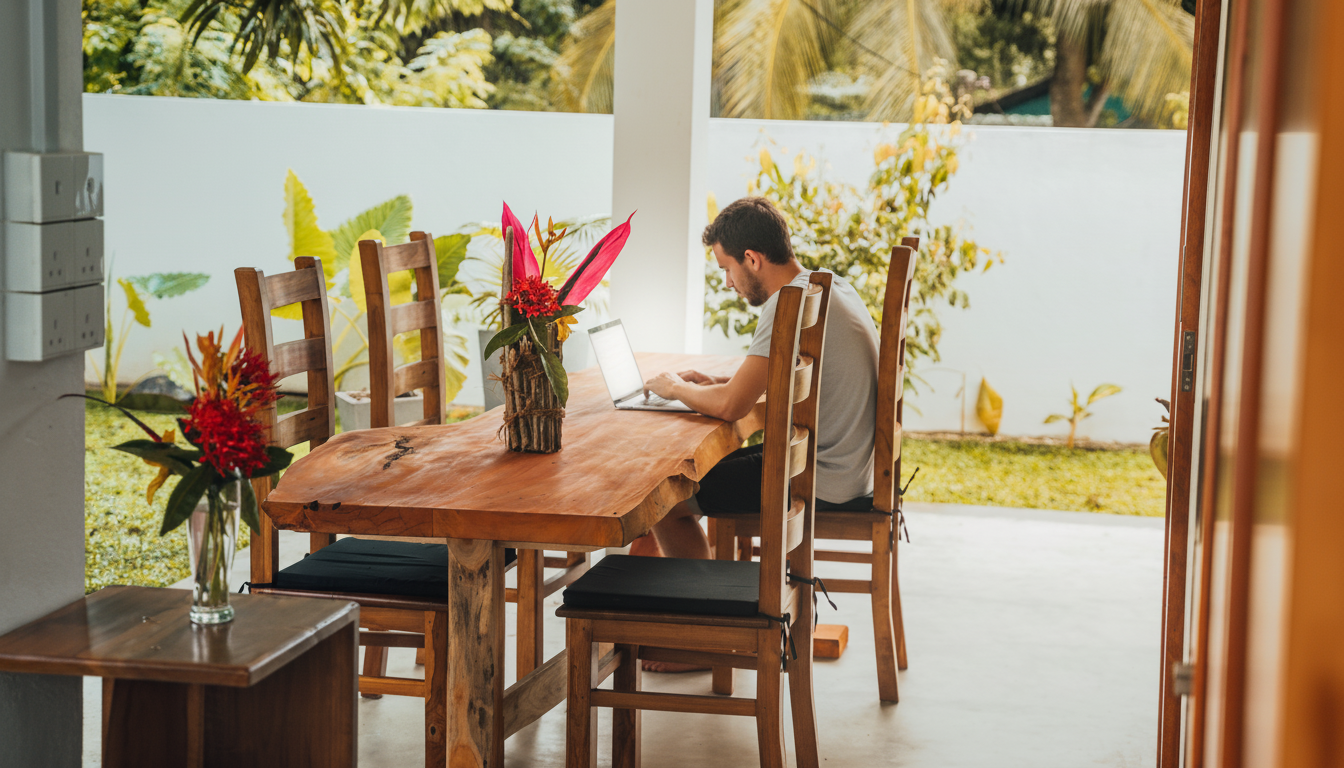
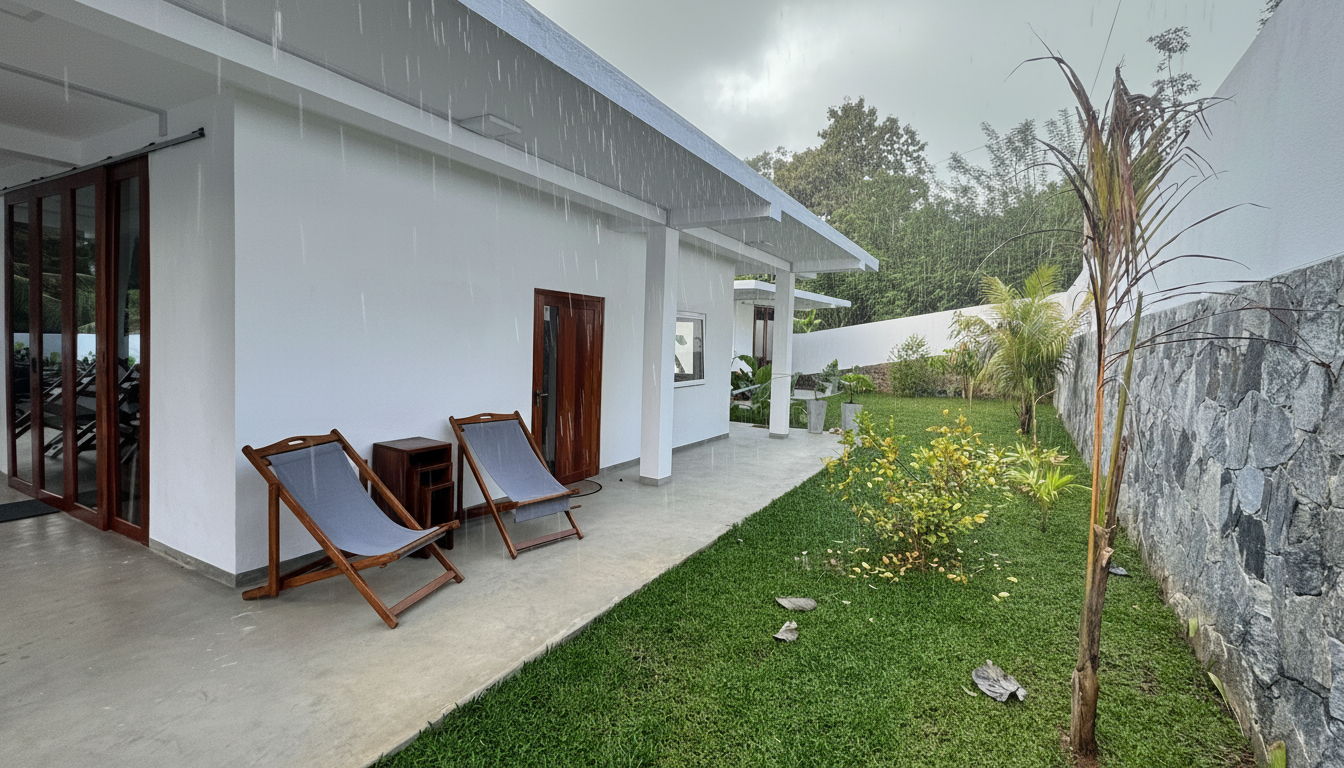
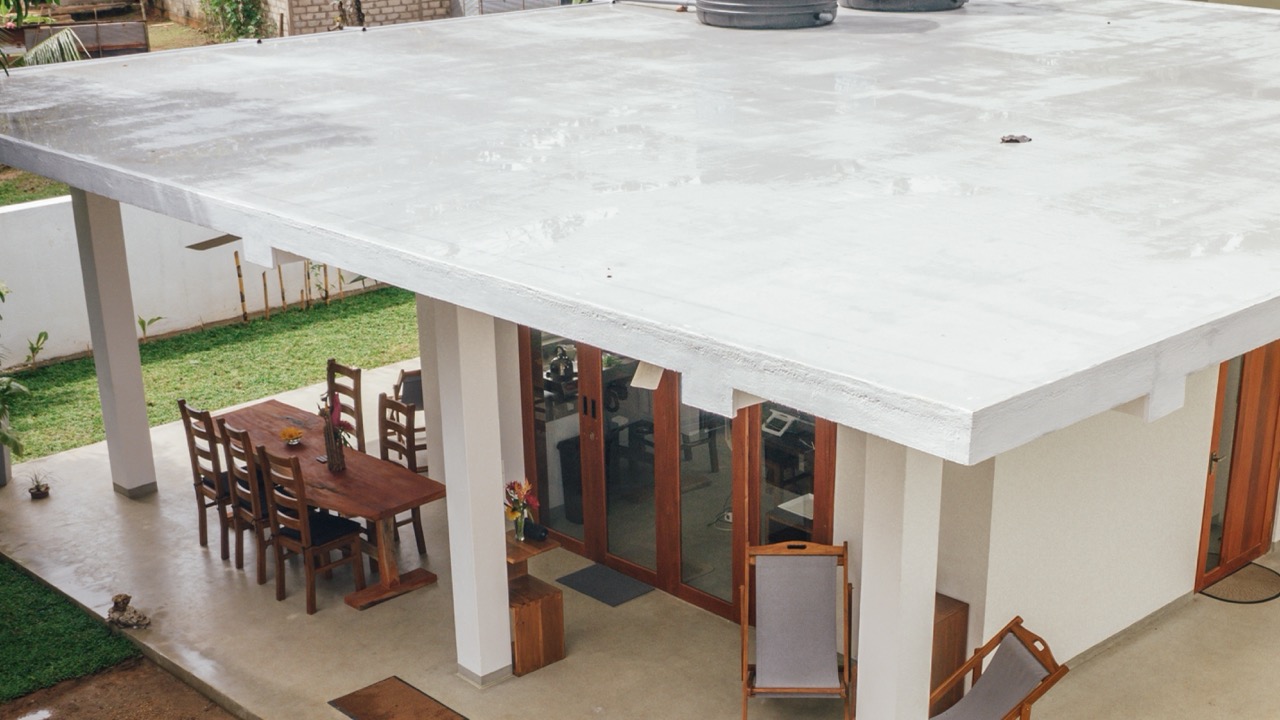
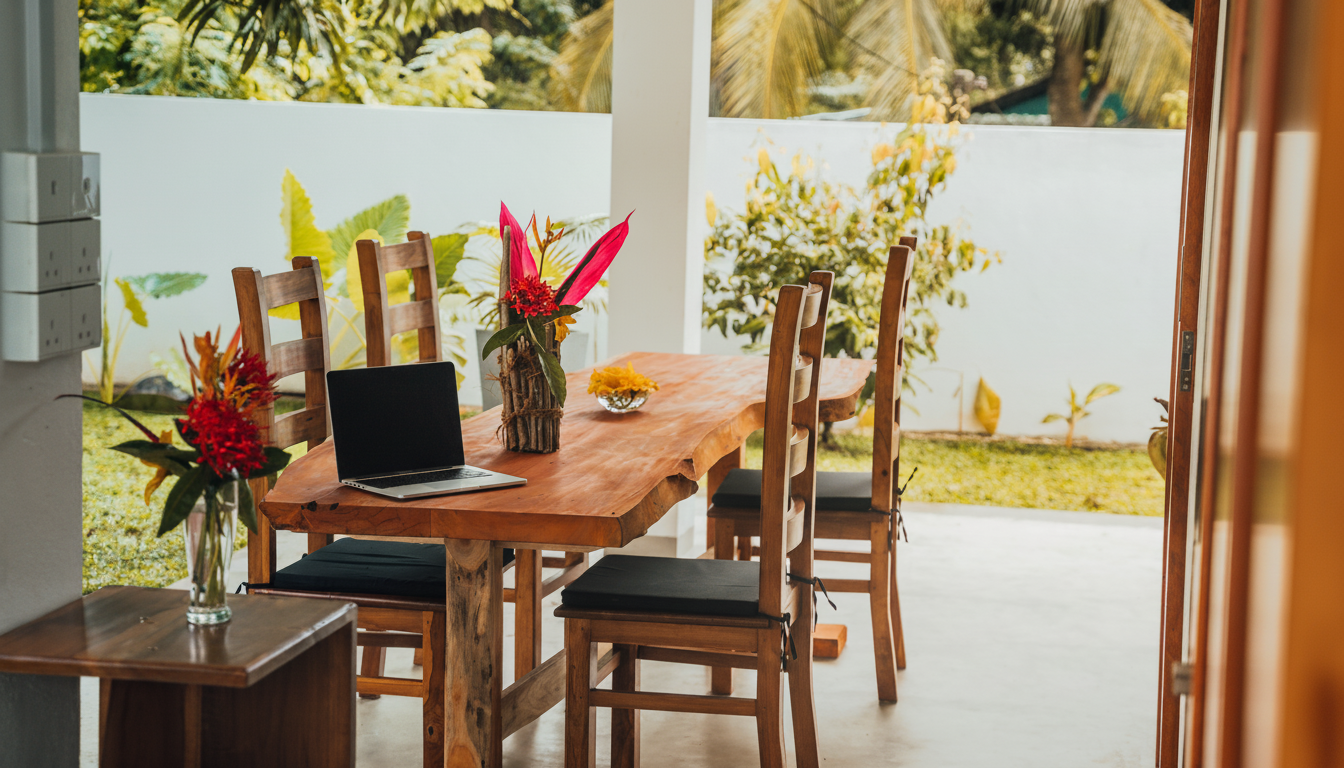
Here's where Aliya Watunu Hena enters the conversation — not as a salvation, but as a different kind of offer. Aliya Watunu Hena is here for professionals who've learned these lessons the hard way. It's not chasing the digital nomad aesthetic. It's not selling 'work from paradise'. It's offering something simpler and more valuable: a place where deep work is possible.
- — Quiet, focused workspace without distraction or hustle mentality
- — Reliable connectivity — Wi-Fi, power, backup systems — because your work depends on it
- — Authentic community of other professionals building real things, not tourist photographers
- — A place that's genuinely meant to be lived in, not just visited
It's 'come here and work better'.
If you've been working remotely for a while and something feels off — you're productive by the metrics, but something's missing — it might not be a work problem. It might be a location problem. Before you optimize your schedule or your tools or your morning routine, ask yourself:
- 1. Can I do deep work here?** Can I focus for 4-6 uninterrupted hours without ambient stress?
- 2. Am I connected? Not just to the internet, but to people doing similar work?
- 3. Do I feel at home? Or does part of me know I'm temporary, always ready to leave?/li>
If you can't answer yes to all three, your location is working against you.
This is where Aliya Watunu Hena comes in — not as the only answer, but as one answer, designed by people who've figured out what remote workers actually need.Explore Aliya Watunu Hena as a workspace → for your best work.